



 Facebook
 X
X LinkdIn
 Copy Link
American presidents face an inescapable dilemma as soon as they are reelected. Because they cannot run again, they find it increasingly difficult to dominate the national agenda. This constitutional limitation makes it increasingly difficult for presidents to “herd the cats” in their own party, filled as it is with prospective successors, and to defeat the opposing party, which sees the golden opportunity of winning the next midterm election. Those upcoming elections almost always go against the party-in-power since it is far easier to mobilize angry, negative voters than satisfied, complacent ones.
Donald Trump is fighting tenaciously to postpone the impact of these indelible features of American politics, but he cannot escape them entirely.
It’s obvious Trump needs to act – and act swiftly and effectively. The President and his party have suffered some telling setbacks over the past two weeks, which show just how difficult the task is. The latest was the loss of the mayoralty in Miami, which Republicans had held for decades. In Nashville, they managed only a modest victory in a “deep-red” congressional district, which Trump had won by over 20 points in 2024. The narrow margin this time came despite a strong Republican congressional candidate and a weak Democratic one, who had publicly smeared the city she hoped to represent and whose far-left views were out-of-touch with most constituents. Mid-Tennessee is not Midtown Manhattan.
The President is also facing pushback on his signature policy: immigration. The problem is not with closing the border. The public loves that and loathed the Biden policy of throwing open the border and lying about it. The problem is not arresting and deporting violent criminals. Again, the public supports that. The problem, according to polls, lies in mass sweeps that arrest and deport illegal aliens who have not committed violent crimes. Still, the Trump administration is pushing forward with that policy and taking heat for it.
The Democrats have one more advantage, going forward: messaging on the economy. They have succeeded in framing the economic challenges facing voters as one of “affordability.” That rings true with most voters, despite high GDP growth rates, and turns their attention away from “inflation,” which was far higher during the Biden years. The higher numbers under Democrats were the predictable effect of unrestrained federal spending, dumping trillions of extra dollars into the economy after the Covid crisis had passed and printing money to pay for it. We are still living with the effects.
Under Trump, inflation has come down significantly – it is now just under 3 percent – but the issue is still serious since the current rate is above the Federal Reserve’s longtime target of two percent. President Trump wants the Fed to lower interest rates significantly with repeated cuts, and he wants them to do it now. He has excoriated the Fed and its outgoing chairman, Jerome Powell, for waiting too long and acting too slowly to lower those rates, which would spur economic activity and help Republicans at the ballot box. Unfortunately, more aggressive action on interest rates also risks continued inflation above the Fed’s target. They are damned if they do, damned if they don’t.
It’s not all bad news for Trump and his party. They have some formidable strengths. One is fundraising, which is always easier for the party-in-power. Republican coffers are full, so they will have no problem getting their message out. Expect them to spend heavily on the midterms. The national Democratic party, by contrast, actually had to borrow money to keep the lights on.
The US economy is also strong, despite complaints from cash-strapped voters. GDP growth is high, nearly 4 percent, and shopping totals for Black Friday set new records, belying consumer complaints about tight budgets. Unemployment is still low, despite sluggish growth in the job market.
Tax cuts will help, too. Those were passed in the “One Big, Beautiful Bill” and will kick in on January 1. They should buoy the economy still further. So should the trillions in inward investments spurred by Trump’s aggressive tariff policy and the prospect of more nationalist policies going forward. Companies want to produce inside those tariff walls. (The tariffs, imposed by unilateral presidential action, could well be overturned by the Supreme Court this spring. But, whatever the decision, huge new investments are already in progress.)
Finally, Trump is an effective salesman for his agenda and faces a Democratic party without a leader or a message, beyond “we oppose Trump.” In fact, Trump has been so vigorous and so aggressive with his Executive Orders that the label, “lame duck,” has rarely been used.
So far.
It’s a devastating label, and Trump wants to avoid it as long as he can. That’s one reason for his renewed public rallies. He needs to show the public and his party that he is still in charge, that his power is not fading.
How quickly it will fade depends mainly on the midterm elections next November. Republican chances depend on sustaining a strong economy and ensuring wages outpace inflation. Democrats’ chances depend on the historic pattern of voters rejecting the incumbent party.
That race has already begun. Trump’s campaign rally in Pennsylvania shows that he knows it.
Is Trump becoming a lame-duck president?
He needs to show he is still in charge going into the midterms after recent setbacks
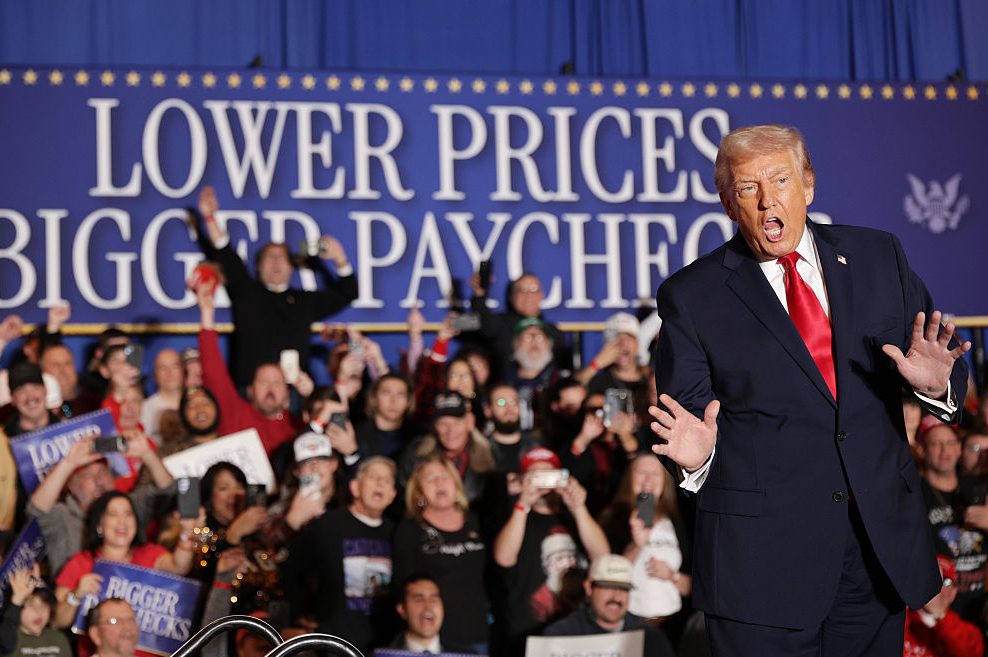
Donald Trump delivers remarks an event at Mount Airy Casino Resort on December 9, 2025 in Mount Pocono, Pennsylvania (Getty)
American presidents face an inescapable dilemma as soon as they are reelected. Because they cannot run again, they find it increasingly difficult to dominate the national agenda. This constitutional limitation makes it increasingly difficult for presidents to “herd the cats” in their own party, filled as it is with prospective successors, and to defeat the opposing party, which sees the golden opportunity of winning the next midterm election. Those upcoming elections almost always go against the party-in-power since it is far easier to mobilize angry, negative voters than satisfied, complacent ones. Donald Trump is fighting…
Share
Is Trump becoming a lame-duck president?
https://thespectator.com/topic/donald-trump-becoming-lame-duck-president-midterms/

Facebook

Twitter

Print

LinkedIn

Messenger

Email
Text
Text Size
Small
Medium
Large
Line Spacing
Small
Normal
Large
Next reads








Leave a Reply