



 Facebook
 X
X LinkdIn
 Copy Link
I’ve been in and out of Germany a lot in recent months and it’s hard not to gain the impression that its society is falling apart at the seams. Wherever you go, there seem to be angry political rallies and street protests. The news is full of violent attacks on politicians and activists. The fear is of a resurgence of far-right sentiments nearly eight decades after the fall of the Nazi regime. The concept of irrational German angst has become a bit of a cliché over the years but this time the threats to social cohesion feel very real.
The sheer brutality of the attack is enough to appall people but it follows a wave of aggression against politicians and activists
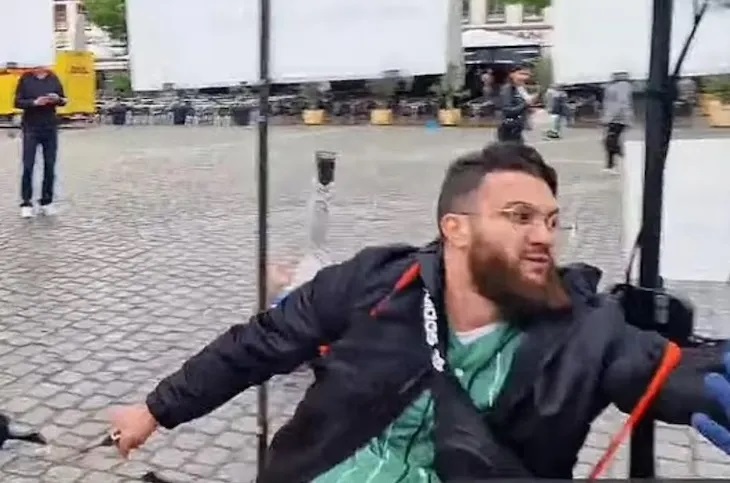
The latest incident to shock the country happened on Friday when an activist was stabbed in the face in broad daylight. Michael Stürzenberger of the anti-Islam group Citizens’ Movement Pax Europa was about to speak at the market square of the southwestern city of Mannheim when he was attacked. Bystanders and police intervened, and the knife-wielding man turned his attention on them, killing a police officer and injuring five others.
The sheer brutality of the attack in the middle of a German city is enough to appall people but it follows a wave of aggression against politicians and activists. Last year alone there were 3,691 offenses against officials and party representatives, eighty of which were violent. This year, the issue caused a huge debate when the Social Democrat Matthias Ecke was attacked by four men in Dresden in early May, receiving facial injuries that required surgery. A few days later, Berlin’s senator for economic affairs Franziska Giffey was injured when she was attacked from behind and hit in the head and neck with a “bag filled with hard contents,” according to police.
This series of assaults on politicians and activists fuel wider fears around the state of Germany’s post-war order. It wasn’t such a long time ago when the country had a reputation for being one of the most stable democracies in the world. West Germany bounced back from Nazism with low crime rates, an “economic miracle” starting in the 1950s and two major parties seemingly able to cover most voters’ needs. Despite proportional representation, the Social Democrats and the Christian Democrats shared over 70 percent of the vote from 1953 to 2005. Now polls suggest they are now heading for a record low of 46 percent and the right-wing Alternative für Deutschland (AfD) is the second most popular party in many surveys.
The rise in political violence combined with a rapidly shifting party landscape in which a right-wing force is emerging as a major player reminds many Germans of the 1920-30s. AfD politicians and voters have long been called “Nazis” by their opponents, but now a new spate of scandals has sparked fears that far-right sentiments may be more embedded than political polling suggests.
Over recent months, videos have appeared of people singing Nazis slogans to the 1999 party tune L’amour Toujours by the Italian DJ Gigi D’Agostino. In October last year, young people sang “Germany for the Germans, foreigners out” (Deutschland den Deutschen, Ausländer raus) when the song was played at a harvest festival in the northeastern state of Mecklenburg-Vorpommern. Recordings were posted on social media and it became a trend with further cases being reported to the police across the country.
It then made the headlines when a group of revelers at an exclusive bar on the island of Sylt filmed themselves singing the “foreigners out” version. One man was seen doing a Hitler salute and mimicking the dictator’s moustache with two fingers. The footage went viral, and the German press, politicians and public figures condemned the group as “champagne Nazis.” In another incident, students of the private school of Louisenlund in northern Germany were caught doing the same thing at a school party. Such blatant disregard for the country’s post-war taboos by members of the wealthy elite cast unsettling doubts over the idea that this only about the great unwashed.

Germany’s social order is falling apart











Leave a Reply