



 Facebook
 X
X LinkdIn
 Copy Link
The costs of not dealing with climate change are, of course, much higher than the costs of dealing with it. We know this because, as climate campaigners keep telling us, climate change is going to set the world alight and unleash mad tempests which are going to wreak destruction on the global economy. Not a few of them have been trying to prove this by parroting a paper by the Potsdam Institute for Climate Impact Research published in the journal Nature in 2024 which concluded that a rise of 8.5 Celsius in global temperatures by 2100 will shrink the economy by 62 percent. Never mind that hardly anyone thinks that such temperature rises are even remotely likely – we are certainly not presently experiencing even nearly such an upwards trend in global temperature – the paper was widely reported as scientific fact rather than as a piece of highly speculative modeling.
But now it appears that the paper fails even as a piece of speculative modelling. Following a critique by economists at Stanford University in August the paper has been withdrawn by Nature. A cock-up with the data for a single country, Uzbekistan, turns out to have skewed the figures so much that, when corrected, the paper suggested a fall of 23 percent in global economic output, not 62 percent.
Needless to say, the reaction of some climate campaigners has been to say that 20 percent of the global economy is still quite a lot of money, and still shows the dramatic impact of a changing climate. But that is hardly the point. If you can magically reinstate 40 percent of global output by correcting some statistics for Uzbekistan, what does it tell you about the whole exercise? This, and all other modeling of its kind, are essentially useless. Economic forecasts for 12 months ahead have shown themselves to have a pretty appalling record. Why does anyone think that a study trying to predict the global economy in 75 years’ time – climate change or no climate change – has any veracity whatsoever? All the model is doing is reflecting the assumptions which are put into it, which are themselves skewed by the prejudices of the people who build it. In this case, and in the case of all this kind of research, that tends to focus on negative effects of a changing climate – higher temperatures and rainfall – while ignoring the positive changes: fewer cold extremes and a world which appears to be becoming steadily less windy.
According to one often-repeated claim, crop yields are going to collapse, causing widespread hunger – a claim which is in direct odds to real world data showing that crop yields continue to increase. When you look a little more carefully at the models which show yields will collapse you find that they analyse all kinds of negative effects of climate change – that some places may experience desertification, without any attempt to acknowledge that other locations will see more favourable conditions for growing food nor that technology is surely going to continue to boost yields by other means, such as gene-editing and improved cultivation techniques.
One apocalyptic paper in a scientific journal has been exposed as deeply flawed – a piece of news which is unlikely to be reported with nearly as much enthusiasm as the original paper. But that doesn’t mean that we won’t continue to be bombarded with fanciful, doom-laden predictions regarding climate change. There is a deep negative bias in this kind of work, and that will remain the case.
Climate doom is not science
A major paper predicting the economy will shrink by 62 percent has been withdrawn
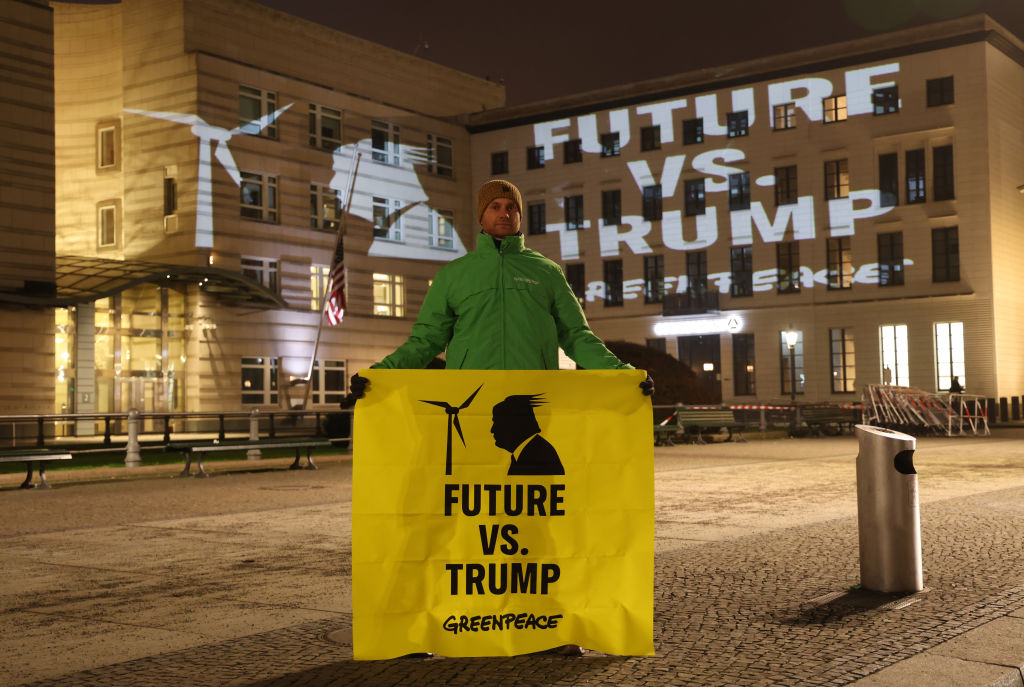
A Greenpeace activist holds a banner that is projected onto the US Embassy in Berlin (Getty)
The costs of not dealing with climate change are, of course, much higher than the costs of dealing with it. We know this because, as climate campaigners keep telling us, climate change is going to set the world alight and unleash mad tempests which are going to wreak destruction on the global economy. Not a few of them have been trying to prove this by parroting a paper by the Potsdam Institute for Climate Impact Research published in the journal Nature in 2024 which concluded that a rise of 8.5 Celsius in global temperatures by…

Share
Climate doom is not science
https://thespectator.com/topic/climate-doom-is-not-science/

Facebook

Twitter

Print

LinkedIn

Messenger

Email
Text
Text Size
Small
Medium
Large
Line Spacing
Small
Normal
Large


Next reads












Leave a Reply