



 Facebook
 X
X LinkdIn
 Copy Link
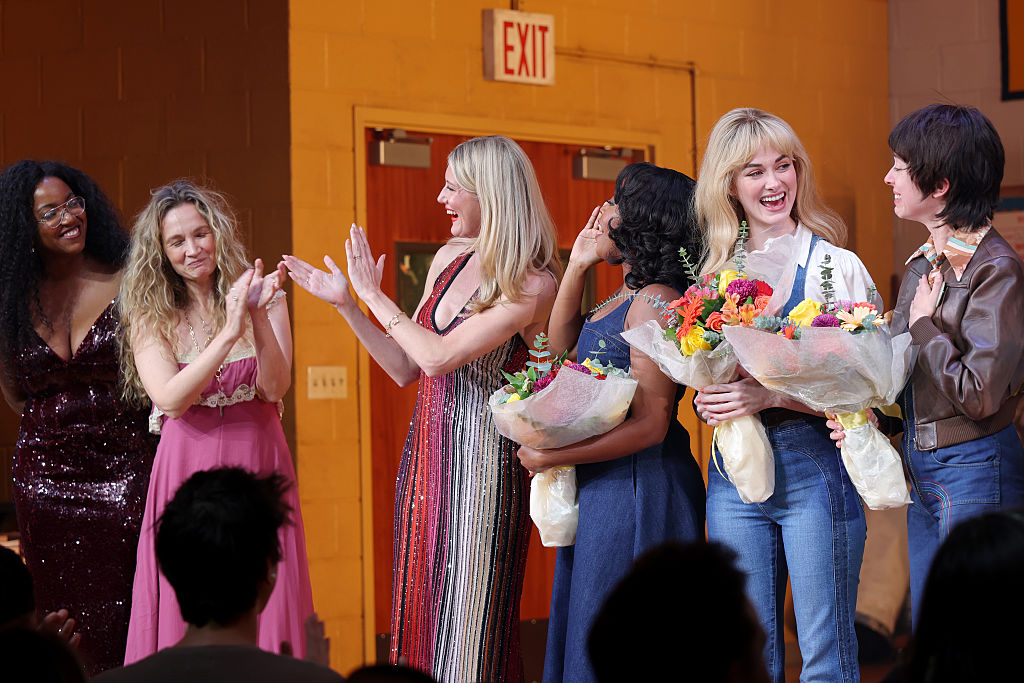
In the second act of Liberation the main cast quietly, and without fuss, starts to undress. By the time the lights go up, all six women are naked. In this masterful play by Bess Wohl, the moment does not feel shocking or gratuitous but somehow comforting.
In 1970s Ohio, a group of women meet weekly to fight for equality through “consciousness-raising.” Mostly that consists of free-ranging conversation, of which the women have a lot and which is always smart, funny, vulnerable and eye-opening. But after reading an article about body positivity in Ms. magazine, they meet in the nude.
As one group member, Dora, ostensibly the most beautiful, breaks down about the pressures she feels and the ways in which she limits and denies her desires (she has never had an orgasm), the other women, still naked, kneel around her. Under Whitney White’s gorgeous direction, the scene is serene – like an oil painting in the flesh.
That portrait of women gathered intimately is at odds with where it takes place: in a bare-bones recreation center. Liberation premiered earlier this year in a downtown New York basement theater. That setting helped create the atmosphere of a group relegated underground. But, thanks to David Zinn’s nostalgic set design, the play has not suffered in its move to Broadway. The stage is bigger, but the sloppily painted white brick walls, basketball hoop and cheap fold-up chairs all feel bona fide. More than that, they make a point: the women must meet in a male-dominated space: you can almost smell the testosterone.
Liberation begins with an unnamed woman addressing the audience directly. She tells us that she recently lost her mother Lizzie, and that her grief has spurred her to question her own life as a working mother of two – in which she feels frazzled and compromised. To address her thorny present, she is exploring Lizzie’s founding role in a 1970s feminist group through re-enactments and interviews with the surviving members.
She explains that she wants to reconcile the young Lizzie – a fierce feminist who believed marriage to be an outdated form of ownership and servitude – with the woman who raised her, who took on a more traditional role as a wife and mother.
With that, Liberation dips in and out of the present and past, expertly guided by the empathetic and authentic Susannah Flood, who plays both Lizzie and her daughter. Flood is so genuine – particularly when she riffs with the audience – that reality easily blurs.
All the women in the group face frustrations. Young Lizzie, a journalist, studied international relations but is assigned to weddings and obituaries. Then there is Dora (Audrey Corsa), a Bambi-faced secretary with big ambitions who is thwarted by her piggish male bosses; Italian immigrant Isidora (Irene Sofia Lucio), who must stay in a loveless marriage for a green card, praying she doesn’t get pregnant; Susan (Adina Verson), a spirited lesbian with a radical “womanifesto”; and Celeste (Kristolyn Lloyd), a book editor and the only black member of the group.
The one woman not young and vibrant is Margie (Betsy Aidem), a housewife in her sixties who has adult sons and a husband so reliant on her he is unable to make himself a pot of coffee. But the reliance goes both ways. Margie is tragic because she is so stuck: she has no financial acumen (she has never paid a bill) and little independence (she can’t drive and doesn’t have a bank account). She is also smart and droll, as are the rest of the cast.
This wit is what makes Liberation so joyous: its characters are delightfully complex and great company. Despite their struggles, they never lose their sense of humor or fun. Isidora, for example, was raised by abusive nuns. But, she shrugs, “at least they were women in leadership positions.”
Wohl doesn’t shy away from tricky questions. When Lizzie falls in love and agrees to marry the ruggedly handsome Bill – a winning Charlie Thurston – her friends are furious that she has succumbed and agreed to become a wife. The lofty goals of the group fizzle into resentment and recriminations. “Shouldn’t I be free?” Lizzie argues. “Shouldn’t I be free to make my own choices – isn’t that what we’re fighting for?”
In other words, this isn’t a feel-good drama about a bunch of plucky individuals who worked together to knock down the patriarchy, but a knotty play in which ideals constantly battle real-life compromises.
It works on many levels: as a commentary on life as a woman in America today, as a historical piece, as an exploration of second-wave feminism and where it fell short, as a look into what freedom means and for whom; and as an investigation into the pitfalls of writing and memory. Above all, it provides no answers – it only asks the audience questions.
This article was originally published in The Spectator’s December 22, 2025 World edition.


















Leave a Reply