



 Facebook
 X
X LinkdIn
 Copy Link
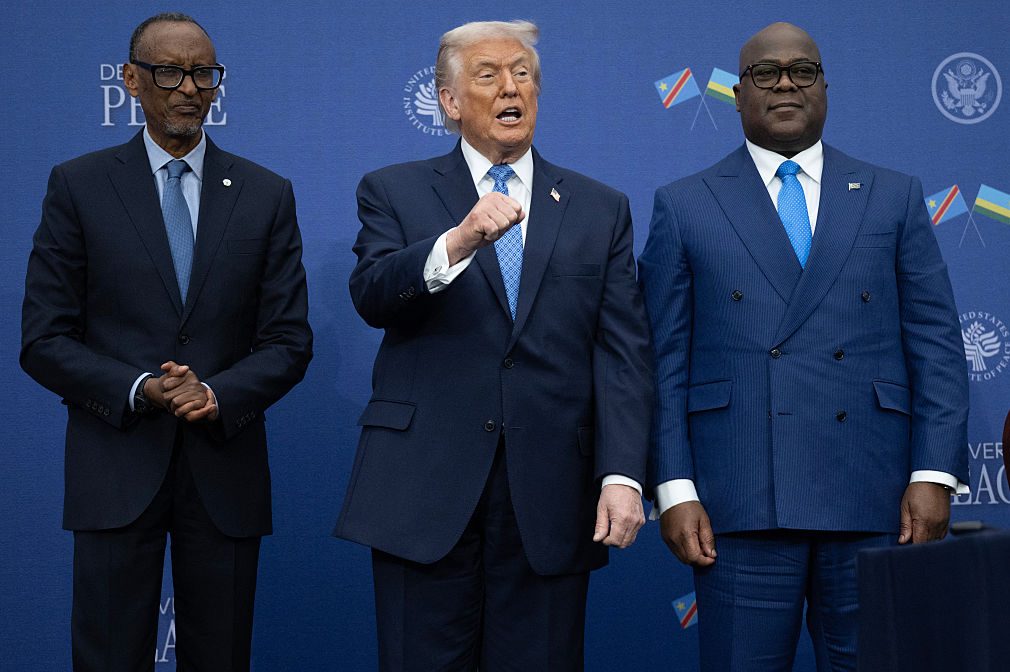
The US Institute of Peace was taken over by DoGE in January and now appears to have undergone a makeover both inside and out. Its new name is emblazoned on the front: “Donald J. Trump Institute of Peace.” The President loves deals and good branding, perhaps as much as he professes to love peace. On Thursday, in the high-ceilinged atrium of the building, he hosted a celebration of a peace agreement between the Democratic Republic of Congo and Rwanda.
The actual peace agreement in question was signed over the summer with shaky results. Nevertheless, leaders from several East African nations, as well as the UAE and Qatar turned up to bear witness to the ceremonial acknowledgement of the agreement. The stage was adorned with a blue banner proclaiming: “DELIVERING PEACE: DEMOCRATIC REPUBLIC OF CONGO – REPUBLIC OF RWANDA PEACE DEAL.” Trump entered an hour late and began by congratulating everyone, himself included, on the agreement. “This is the first time we are using this building for peace,” he said.
The treaty was billed as a final end to the mess of bloody conflicts which has been occurring in the two countries for at least three decades, causing the deaths of millions of people. This conflict – really a series of wars and civil wars, intertwined by ethnic violence – has always baffled Washington. The agreement was to involve Rwanda withdrawing its support of rebel group M23, the removal of Rwandan soldiers from the DRC, while on the Congolese side, a militia called the Democratic Forces for the Liberation of Rwanda (FDLR) would have to be eradicated.
Matters were always complicated by the fact that M23 is a separate entity from Rwanda – and Rwanda does not formally claim to back them. Direct talks taking place between M23 and Congolese forces are still a point of unresolved tension and uncertainty. People have said that the fighting has not stopped since the summer when the agreement was reached. “Many administrations have tried but probably not too hard [to end the conflict],” Trump said, “but we tried harder.” Trump never misses an opportunity to demonstrate his diplomatic prowess in comparison to his predecessors. He wants to be a hero – and there’s no shame in that. If the war finally ends as a result of this agreement, Trump may deserve his name on the USIP building after all, but it has not happened yet, nor is the agreement brand new as of today as presented.
Trump praised the leaders of “two potentially very powerful nations.” The subsequent speakers expressed gratitude and resolve, if also a little trepidation. An impressive machiavellian strategist in his own right, Rwanda’s President Paul Kagame highlighted the importance in Trump’s pragmatic approach to peace: “He orients us toward the future, not the past, emphasizing that the dividend of peace is prosperity and investment.”
Rwanda, despite its crimes both proven and alleged, has been a success story in Africa. A tiny resource-poor landlocked country that endured one of the worst genocides in modern history has recently led the continent in pace of development. Kagame, who has been President since 2000, has turned his nose up at foreign aid and instead has his eyes on economic independence and participation in the global economy. This renders him a natural ally of sorts to Trump, who wants access to the critical minerals in DR Congo. Kagame has closer proximity to these minerals and has sought more access to them through this conflict.
The agreement has been framed as an economic deal, meant to make all parties richer and replace the killing. As with most of the peace treaties struck in his second administration, increased trade between the United States, Rwanda and the DRC was a clear motivator for Trump’s involvement. “We’re sending some of our biggest and greatest companies over to the two countries, and we’re going to take out some of the rare earth, take out some of the assets, and pay and everybody’s going to make a lot of money.”
“Not only is it doable but I think it’s going to be a great miracle,” Trump said. It is not clear if this event was meant to serve as a kind of pep talk for the leaders of the DRC and Rwanda or as an exercise in reputational management on behalf of the leaders of the United States. What we do know is that this situation is not as simple as expecting a miracle.
During the ceremony, Kagame spoke carefully in accented but elegant English. Like the Trump administration, Kagame’s government has centered the strategic importance of English being spoken in his country, and switched the official language of instruction in Rwandan schools from French to English in 2009. Felix Tshisekedi, the President of the DRC, where French is the language of education and government, used a translator.
In the background, Trump’s desire to secure peace prizes is conspicuous. The Democratic Republic of Congo is among a list of interested countries who have nominated Trump for the Nobel Peace Prize. He is expected to win the FIFA peace prize this week – newly introduced last month by FIFA president Gianni Infantino – without the knowledge or approval of the FIFA Counsel or his VPs – ahead of the World Cup draw taking place at the Kennedy Center Friday. Infantino was also present for Thursday’s proceedings.
The strong Biblical undertones in the ceremony point to some rhetorical overlap between the leaders of these two Christian (largely Catholic) countries and evangelical America’s chosen candidate. Ecclesiastes was quoted. This is a time for hope, everyone insisted. The Prince of Peace (not Trump, the other one) got a mention as well.
Meanwhile, the Trump administration’s contentious drone strikes in Venezuelan waters have been justified by the assertion that America is “at war” with that country’s cartels. Trump has said any country producing illegal drugs destined for the United States could undergo military attack. Blessed are the peacemakers… wherever they are.








Leave a Reply