



 Facebook
 X
X LinkdIn
 Copy Link
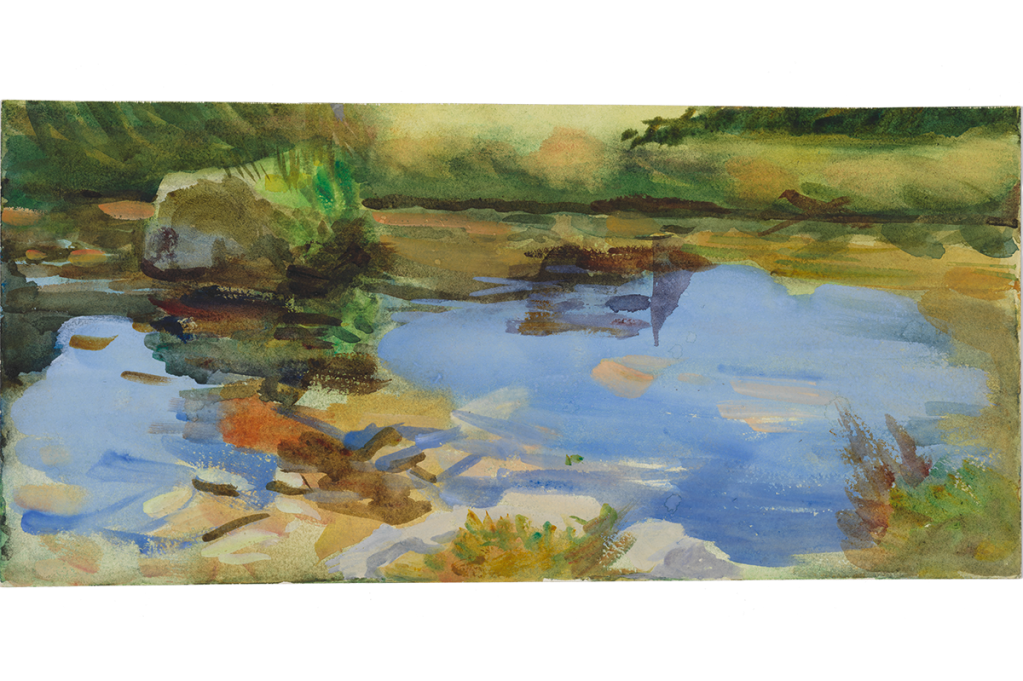
When your brother is one of the most successful artists of his time, you might feel reluctant to pick up a paintbrush. Yet, the works of Emily Sargent, in the Metropolitan Museum of Art’s Portrait of a Family, prove that she was an artist in her own right. Sargent (1857-1936) was not in her brother’s shadow, although she was undoubtedly in his debt.
John, Emily and their sister Violet were the children of FitzWilliam Sargent, a successful Philadelphia physician, and the artist Mary Newbold Sargent. By the 1850s, the Sargent family were living a nomadic existence in Europe – John and Emily were both born in Florence. Encouraged by their spirited mother, the Sargent children were instructed that no matter how many sketches were begun in a day, at least one must be finished. This demand of daily drawing sharpened their skills of observation, facility and technique. John’s talents were clear from an early age, with one family friend noting that he worked “with vehemence and accuracy.” This exhibition demonstrates this quality in two of John’s works from the 1870 “Splendid Mountain Watercolors” sketchbook, one a landscape, one an interior with peasants – both accomplished in composition and technique. Emily was guided toward the more ladylike medium of watercolor.
Emily and her brother painted alongside each other on numerous occasions and even collaborated on “The Brook, Purtud” (1906-08). It is tempting to try to guess which hand is John’s and which that of his sister. But what comes through is that the siblings enjoyed an amicable relationship in which they freely exchanged ideas, tips and impressions about art.
That kind of cross-pollination is evident in, for example, Emily’s “Garden Scene with Trellis and Trees” (c.1910), a breezy work clearly influenced by John’s watercolors in Corfu. Neither sibling married and Emily spent much of her adult life helping to manage John’s high-profile career. A childhood spinal injury (or possibly spinal tuberculosis) troubled her throughout her life, but it did not prevent her from traveling widely and recording scenes across Europe, Egypt, Jerusalem, Constantinople, the US and Canada. This – dare we presume – was life as she wanted it. But the curators can’t resist questioning Emily’s lost potential. “What might have become of Emily Sargent if she had been afforded the same artistic opportunities as her brother?” asks one wall plaque. We are also reminded that Emily had little professional art training and was considered an amateur because she never exhibited professionally. If Emily had wanted to be another Élisabeth Vigée Le Brun, painting portraits of grandes dames and their daughters, she might have been, had she possessed that drive and desire. She certainly had the connections, living and traveling as she did in proximity to a brother whose international reputation could have brought her clients and prestige.
Rather, Emily’s particular form of “self-actualization,” a phrase that would surely have baffled her, is a formidable body of work (some 440 watercolors were discovered in 1998) and newfound critical consideration as an artist. Her quiet mastery of the unforgiving medium of watercolor is clear and her ability to render transitory light effects – glittering water, changeable desert skies, shadowy ponds, sun-drenched walls, glowing leaves – impressive. The work is a tad uneven, but the overall effect is revelatory, due in no small part to her experimental approach and the application of materials such as wax resist with its crayon-like scumbling.
The high point of the exhibition is a set of five pairings in which John and Emily each interpret a similar scene: a Cairo marketplace, a corner of the Alhambra, a Venetian church, the Judaean desert and a waterfall in the Simplon Pass in Switzerland. They each chose independent viewpoints and focused on different features to create works unique in temperament and style. Each utilizes white space untouched by pigment to create the whitest white, and each has a keen eye for subtleties of color. At first, Emily’s “Alhambra” (1903) seems diffuse and unfocused compared to her brother’s “Spanish Midday, Aranjuez” (1903) where the assured composition and a sunlit marble bench dazzle the eye. But this isn’t a competition, it is an exercise in interpretation.
In “From Jerusalem” (1905-06), for example, John vigorously delineates the colors and shadows of the desert, even larding on pigment for a crusty, white sun. Emily’s “Dead Sea” (1904) is more abstract, with amorphous, rolling sand dunes, lavender shadows and a blurred horizon. In fact, her daring technique with its brushy strokes and undifferentiated layering subtly challenges her older brother’s rather more romantic impression.
Will this exhibition vault Emily Sargent into the heights occupied by her illustrious brother? Unlikely, and unnecessary. That John was able to parlay his ability and his cosmopolitanism into a prestigious career enabled him and his sister to live comfortably, flourishing as artists in a world that might have been closed to them had they not grown up in it. Later, when John grew tired of painting society portraits, he could withdraw from that world and he and his sister could travel and paint where and when they liked. Emily continued to benefit, living a life of comfort and creativity in proximity to genius without its obligations.
This article was originally published in The Spectator’s December 8, 2025 World edition.















Leave a Reply