



 Facebook
 X
X LinkdIn
 Copy Link
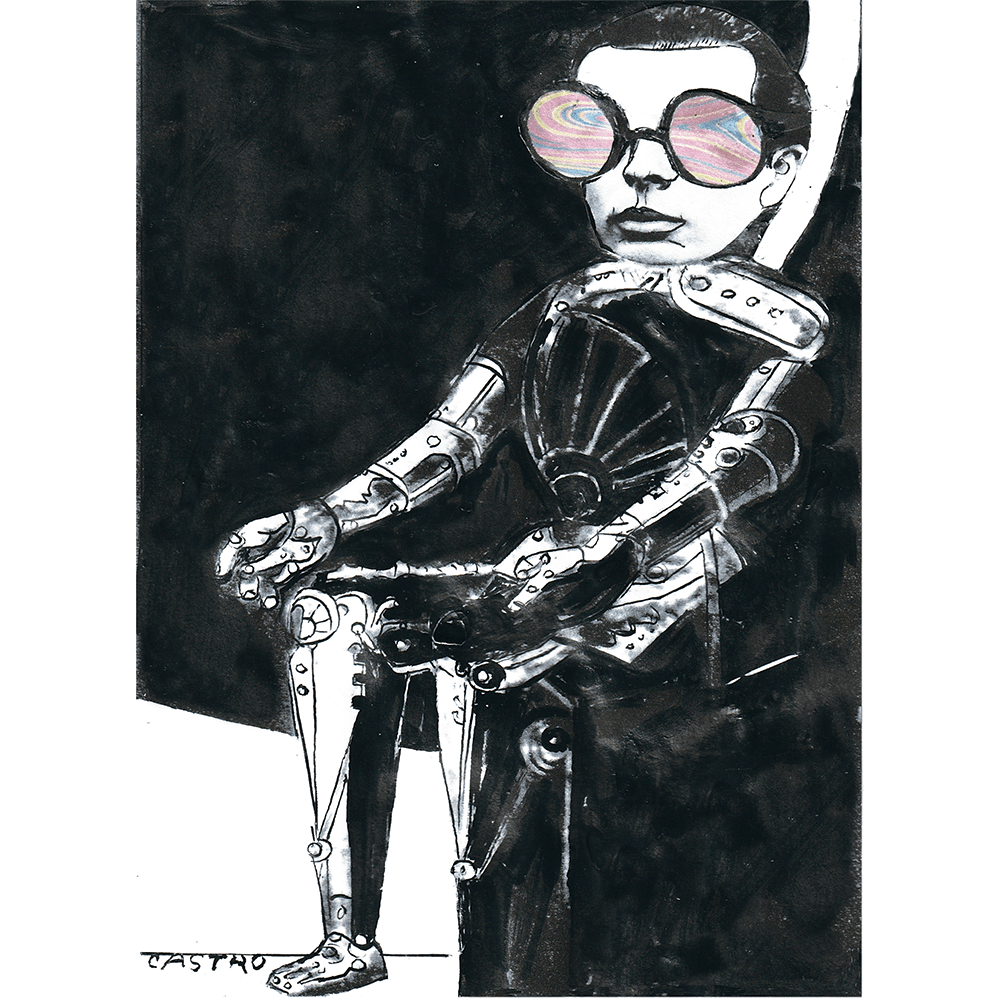
In 1961, just two years before he died in Los Angeles, the polymath, philosopher and novelist Aldous Huxley gave humanity a warning. Much of his prophecy about society in Brave New World had come to pass, he said, which made him even more certain that the standout problem of the future would be our inability to resist becoming enslaved to our own technology. Now, more than 60 years after his death – and with an entire generation of children frying their brains with smartphones and nobody able or willing to do anything to stop them – it is hard to deny that he was onto something.
The man was destined to be a prophet for our gadget-addled age. Born to one of England’s most accomplished family dynasties, he entered the English boarding school Eton on a scholarship only to find himself suffering from a debilitating eye disease leading to near-total blindness, which forced him to learn Braille. Refusing to accede to his condition, he turned to an alternative technology, a technique known as the Bates method; a peculiar and much maligned pseudo-science akin to Rolfing, Reiki and various forms of homeopathy. Huxley swore by the practice, later claiming it gave him enough vision back to attend Oxford in 1913 and, much to humanity’s good fortune, to begin writing.
One of the more unusual consequences of his disability was a near-total reliance on dictionaries and encyclopedias. Unable to read the poetry or novels of his youth, Huxley would pick an entry and spend hours memorizing the words, etymologies and facts underneath. Then, strolling over to literary dinner parties, he would talk about nothing else except what he’d read that day. Picking the letter “T,” for instance, Huxley would propound the derivation of the word “treacle” from the Greek theriake. A genius? Yes. The life of the party? Probably not.
Huxley published tens of novels, nonfiction books and short stories, the majority of them largely forgotten. But it was in 1932 that he became a household name with the publication of Brave New World. Still taught today as a prescient glimpse into the future of human civilization; the dystopian novel described a society in which the traditional family has been eroded, global governments foster mass conformity and humans are hooked on trivial consumption, homogenous and two-dimensional political attitudes and artificially stimulated novelty via a strange drug known as soma. Today, we’d just call it TikTok. The rest we’d call modern America.
We forget it now, but Huxley began sketching out the book after the mass disillusionment and carnage caused by World War One put an end to the 19th century’s long flirtation with progress and utopia. The basic message of Brave New World – that technology accelerates totalitarianism and mass propaganda – was right.
Today, few of us can avoid being told that generative AI is “just a tool,” but Huxley understood quite intuitively that technology begins to enslave us no matter how much we think we’re in control. And this was long before social media and short-form video clips so effectively managed to annihilate our attention spans, induce mass-hypnotic behaviors around strange foreign conflicts and destroy our ability to do the very thing Huxley prized most of all: sit down, quietly, and read a book.
By 1937, just two years before the outbreak of another catastrophic war in Europe, Huxley moved to the United States – but like many Englishmen in America, he was let down by what he found. This was nowhere more so than in Los Angeles, which he described as “19 suburbs in search of a city – a nightmare of neon and billboards.” Some things don’t change.
Yet he deeply loved the country’s landscape and could often be found far out in the Mojave Desert, where he owned a small cabin without electricity which would serve as a place of rest and, later on, for his meditative spiritual practices. Indeed, it was there that his career took a remarkable turn. Until then, Huxley’s worldview was a typically materialist one; perhaps no surprise given that his grandfather, Thomas Henry Huxley, was known as “Darwin’s Bulldog” for his long-term commitment to the scientist and his then-polarizing theory of evolution. Aldous, then approaching middle age, once called Buddhist meditation “the first cousin of the doze,” but he still wanted to consciously taste the visionary experiences of his hero William Blake. Blake was one of those few individuals in history who appeared to be constantly tripping without any psychoactive assistance – he said he saw God looking through his bedroom window as a child, for instance. Huxley’s route to spiritual experience was mescaline.
In 1950, he sat down in his living room alongside psychiatrist Humphry Osmond and ingested 400 milligrams of the stuff, kickstarting history’s most beautifully articulated psychedelic experience which he describes in The Doors of Perception. That book covers everything from the sublime beauty of flowers, the ravishing sensation of listening to Bach and the absurdity of human activity he found when gazing at a 1931 Ford convertible. Now a convert to psychedelics, he dedicated the rest of his life to mysticism.
It was in these last years that he wrote Island (1962), which represents a kind of anti-Brave New World by describing what an ideal society might be like. The most famous character in the novel is the mynah bird, trained to squawk the words “Here and Now” at almost every opportunity, reminding the inhabitants of the island that true life exists always in the present moment. The message of world peace pervades the novel, too, something which had become a stronger preoccupation as he ended his life. In a short and polite 1959 letter, he had rejected a British knighthood as hypocritical given his lifelong aversion to titles and uniforms, his identity as an exile from England and his utter repudiation of anything which may have originally derived from violence.
A year after he wrote Island, Huxley lay dying. Diagnosed with laryngeal cancer and with mere hours before his passing, he requested from his second wife 100 micrograms of LSD, via intramuscular injection. He took it, she said, as if it were a sacrament. In The Tibetan Book of the Dead, they say that the period of in-between states at the moment of passing represents the greatest opportunity for enlightenment. If, that is, you can remain conscious enough to recognize the “clear light.” Huxley, no doubt inspired by this ancient wisdom, hoped to reach the final “awakening” himself.
Today, more than 60 years after his passing, it is impossible to deny the prescience of Huxley’s vision. He warned us of the perils of technology and its uncanny ability to enslave us; that we so easily forget that technology was made for us and not us for technology.
But he wrote decades before even personal computers, let alone the total immersion of human life into the ubiquitous and artificial digital world which now defines every single one of us. He would no doubt mourn that young writers following in his footsteps would have no choice but to launch concocted and inflammatory social-media posts simply to stand above the noise – and he would be horrified at AI’s ability to erode what frail critical thinking abilities our species had to begin with. At the same time, Huxley truly believed that psychedelics would be the gateway to the expanded, luminous consciousness which he thought of as our very birthright. This, if anything, was the purpose of human life. Now, as the war on drugs draws to a close, and the growth and prevalence of psychedelic medicine and ayahuasca healing trips continue to go mainstream, maybe we all will soon find out for ourselves what lies the other side of Huxley’s Doors of Perception.
Max Horder is an author and anthropologist. His new book, Written By the Victors, will be published in 2027 by Penguin Allen Lane. This article was originally published in The Spectator’s December 8, 2025 World edition.






Leave a Reply