



 Facebook
 X
X LinkdIn
 Copy Link
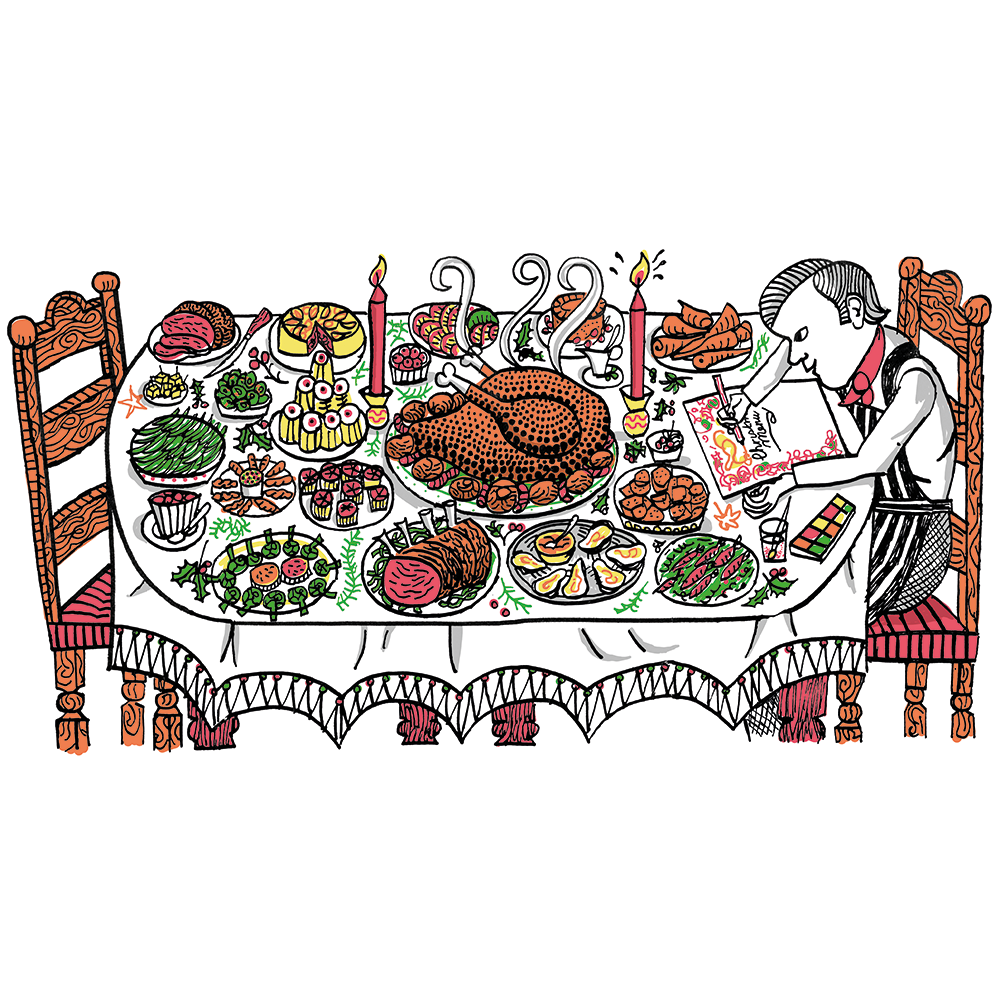
In the early 1970s, celebrity chef Jacques Pépin and his wife bought a dilapidated house in the Catskills so they could go skiing on the weekends. It was a real fixer-upper. Groups of friends would come up from New York City and pitch in on the renovation effort, and Pépin would serve dinner at the end of the day. These weekends were so much fun Pépin decided to memorialize them by hand-lettering and painting special menus.
How Pépin convinced his friends to let him sit in the kitchen sketching petits poissons and heads of broccoli while they slaved away at framing and drywalling his winter getaway is, admittedly, mysterious. Settling in to hand-paint a menu before getting down the pots and cooking a five-star meal doesn’t square well with the image of the DIY weekend warrior leading the charge on home renovations. Clearly, the man was both a culinary genius and a master of persuasion.
And his menus were utterly charming. They grew into a family tradition, where the menu for every special occasion was illustrated, lettered in Pépin’s elegant, curly script and preserved for posterity in the family archives. (They were, eventually, published in book form.) In addition to the list of courses, some had space for les invités, where the guests could sign and leave comments. Sometimes labels from the wine they’d enjoyed would be stuck on as well.
He made menus for outside events too, for instance a Christmas menu for a dinner cooked at Stone Acres Farm in Stonington, Connecticut, in 2016, with the courses listed in black ink and the wines in green. What a feast it was. They began with gougères, goose liver pâté and Stonington scallops. Then they followed soup and grilled Noank oysters with crémant from Savoie and Guy Larmandier Champagne. The pièce de résistance was roast goose with gravy and potatoes in goose fat, accompanied by Châteauneuf-du-Pape. Dessert was an apple tarte tatin paired with Sauternes. Not too shabby.
You might be tempted to dismiss Pépin’s handmade menus as a charming but irrelevant hobby, a sort of chef’s journal. But this would be to overlook the man’s genius. His menus are infused with perhaps the most important ingredient of all, something without which Christmas dinner is doomed: a sense of occasion. Like a wedding, Christmas is a milestone of sorts. Like a wedding, the very concept of Christmas dinner is burdened with expectations, fears and emotions. It demands ceremony and tradition, but also liveliness and warmth. How can this occasion, this time in history, this particular guest list, this family and this place be woven into one unforgettable evening – hopefully without burning down the house?
Handmade menus alone won’t do it, though they’ll help. It takes a master strategy, and the one I propose is straight from the wedding handbook: your outfit (or in this case your dinner), should include something old, something new, something borrowed and something blue.
Something old – that’s easy. Christmas is all about time-honored culinary traditions: stuffed birds, roast boar (as I had once at a beautiful Christmas in Germany), tourtière in Québec, oysters on the half shell gulped down by the French, figgy pudding served up à l’Escoffier in a blaze of brandified glory. Something old puts you in touch with all ages past through the shadowy line-up of ancestors and ever-so-greats, all celebrating Christmas after Christmas, handing it on all the way to us.
But Christmas isn’t only about generations past. It’s also about the future: a fresh start, the birth of the baby Jesus, here to take on the world, live, die and reign forever. So the second element of a good Christmas menu is something new, adventurous and exciting. Time for crown roast of lamb, a terrifying cheese that looks like a brain, roasted brussels sprouts on a giant stalk which you can stand up on a platter in the likeness of a Christmas tree (or piece of medieval weaponry), trays of rich little sea urchins, the foie gras of the ocean.
Thirdly, something borrowed. When it comes to weddings, you borrow your grandmother’s necklace, your best friend’s hair clip or your sister’s shoes (if your sister lets you borrow her shoes, she doesn’t actually want them back, does she? Asking for a friend). It’s the same at Christmas: serve your grandmother’s shortbread, your best friend’s Caesar salad and shamelessly steal your sister’s recipe for mistletoe martinis.
Last but not least: something blue. It needn’t be food (though Stilton is always an option); it can be in the decor, a trick of light, a mood. Christmas isn’t all red and gold and green. Just ask Elvis: “I’ll have a blue, blue, blue, blue Christmas.” Poignancy is part of the day, so they knew in medieval times; their carols were happy, but sometimes startlingly sad: “In sorrow endeth every love but thine, at the last.” Like salt, a pinch of Christmas sadness rounds and deepens the flavors of the day, counteracting the bitter and elevating the sweet.
Blue doesn’t only stand for sorrow. It also represents the precious and the good. When a bride wears “something blue,” it is supposed to mean purity and love. In medieval times, blue pigment from the lapis lazuli stone was the rarest and most expensive color – which is why it was used for depictions of the Mother of God.
So when you settle down this festive season in a corner of your hectic, wrapping-paper-strewn home, like Pépin mid-construction, to paint little watercolor fish and garlands on to your festive dinner menu, don’t forget to work some blue into the pattern. Without the lady in blue, there is no Christmas; without Christmas, there is no Christianity – and without Christianity, it’s a cold, lonely night, with nothing between you and the wolves.
This article was originally published in The Spectator’s December 8, 2025 World edition.













Leave a Reply