



 Facebook
 X
X LinkdIn
 Copy Link
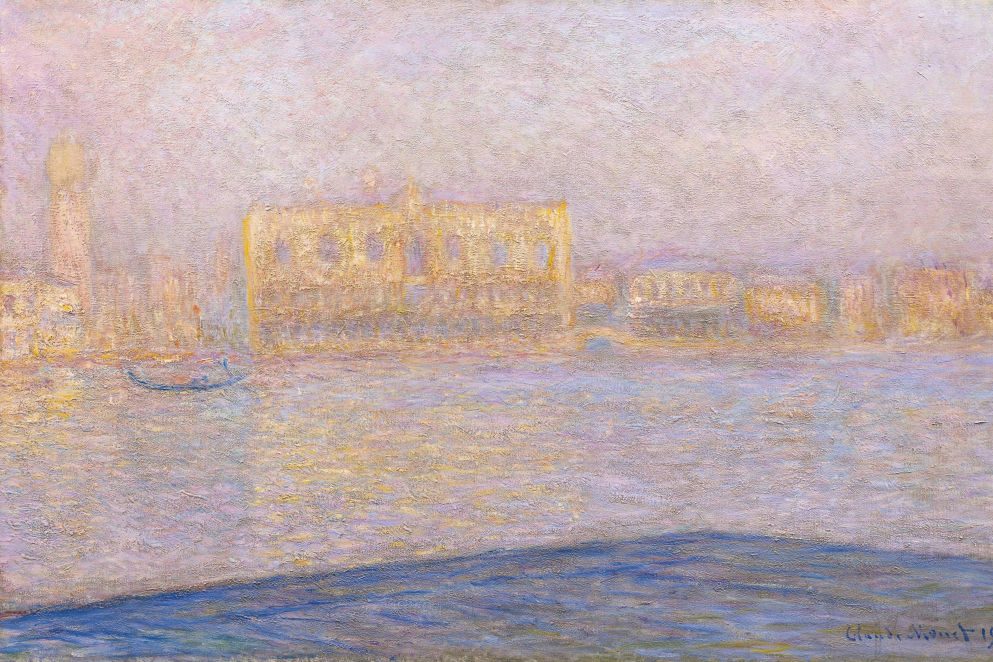
If you crave art that will envelop you, book a ticket, pronto, to Monet and Venice at the Brooklyn Museum. Enveloppe was the term the French impressionist artist Claude Monet (1840-1926) used to describe the “beauty of the air around” the objects and landscapes he painted. “Other painters paint a bridge, a house, a boat… I want to paint the air in which the bridge, the house, and the boat are to be found – the beauty of the air around them, and that is nothing less than the impossible,” he said.
And yet on his 1908 trip to Venice he succeeded in capturing the atmospheric mix of air, water, light and shadow that suffused the floating city of islands known for its distinctive bridges and canals and singular mélange of Byzantine domes, Gothic churches, Moorish-style balconies and Renaissance arches and arcades. Equally significant, the exhibition argues, it was this visit that rescued the 68-year-old artist from the depressive block that took hold of him after his long-time art dealer Paul Durand-Ruel voiced doubts that a market existed for the cycle of water-lily paintings in which he had been so deeply immersed.
With what lame irony Durand-Ruel’s critique resounds today. But the exhibition wisely focuses on the additional masterworks that Monet created in the wake of his impasse. This perspective allows the curators – Lisa Small of the Brooklyn Museum and Melissa Buron of London’s Victoria & Albert Museum – to document the artist’s emotional mindset and creative focus before, during and after his stay in Venice.
The story of how the Venetian sojourn itself came to be also provides a glimpse into the workings of the Monets’ marriage. After Monet angrily vowed to abandon the water-lily project altogether, his glum and listless demeanor so distressed his then-wife Alice Hoschedé that she persuaded him, despite his grumbling, to accept the invitation of the art patron and society hostess Mary Hunter to stay with her in Venice at the exquisitely appointed 15th-century Palazzo Barbaro, situated on the Grand Canal.
Alice’s plan may have begun as a caring (and perhaps exasperated) gesture to divert her husband’s mood, but her resolute insistence led to his creative restoration. Monet begrudgingly assented to a two-week stay, but the trip eventually sparked his mood so greatly that the journey was extended to a two-month working vacation. During that time, the revitalized Monet produced 37 paintings, some of which were exhibited to acclaim in 1912. Nineteen of those canvases appear here, as do several paintings from the water-lily series.
Those lily-pond paintings benefited greatly from the artist’s journey. “My time in Venice has had the advantage of making me see my canvases with a better eye,” he said. “There’s only one step, there and back, from the water-lily pond to the lagoon where the colorful palaces bloom.” For evidence, look to “Water Lilies” (c. 1914-17), a canvas aglow with pink flowers accompanied by shadows cast by foliage and hints of watery vegetation below.
Monet’s reinvigorated Venetian palette announces itself in the joltingly vivid red brushstrokes of “The Red House” (1908, see p41) It is also seen in the more precise daubs used to capture the dappled waves that transform from blue to green to rose and gold and cream and back again, as the water washes against the stony facades of the distant palazzi. Monet painted these scenes en plein air, as was his custom – but in this case from a floating gondola, an adaptation of the floating “studio boat” he’d once used on the Seine. Édouard Manet depicted this practice of Monet’s in “Claude Monet Painting in His Studio Boat” (1874). The scene endearingly shows Monet accompanied on board by his first wife, Camille. Monet’s attention in this painting is focused not on her but the canvas in progress. We see its finished version “Sailboats on the Seine,” painted the same year, mounted nearby.
In Venice, as he had in both London and Paris, Monet also captured another element of the open air: smog, produced by the coal-burning engines of the world’s increasingly industrialized cities. The advent of pollution almost certainly contributed to the hazy blend of colors Monet observed and depicted in such paintings as the 1903 canvas shown here, “Houses of Parliament, Sunlight Effect.” These are the same kinds of atmospheric enveloppes that nearly enshroud in shadow Venetian views such as the alluringly mysterious “The Palazzo Contarini” (1908).
Gallery by gallery, visitors also get to see the storied city as viewed over the centuries through the eyes of myriad artists, photographers and visitors. Seeing historic sights through the differing artistic sensibilities of Canaletto, J.M.W. Turner, John Singer Sargent, James McNeill Whistler and Pierre-Auguste Renoir is a discourse itself on creative perception, demonstrating the wide array of angles, styles and personal slants each artist brought along on their travels – and subsequently shared with us.
Unfortunately, as you enter the exhibition – before you see a single Monet or even a postcard – you enter an introductory gallery filled with giant videos of Venice in an immersive montage that may please some but struck me as superfluous.
Far more relevant are the exhibition’s archival reels, recorded by the Lumière brothers and others in the 1890s and early 1900s. These snippets show canals bursting with gondolas and piazzas crowded with tourists. Numerous prints, postcards and other works on view also attest to the sightseeing throngs abroad throughout the city. Canaletto’s precisely rendered scenes similarly capture the commotion of the harbor, where sailors and workmen busily ply their trades. In a subtler vein, Sargent’s series of evocative watercolors from 1903-04 (standouts include “La Riva” and “The Bridge of Sighs”) present scenes that suggest calm and beauty can be found even amid the bustle.
But in contrast to the buzz and the busyness portrayed by others, Monet’s Venice is nearly devoid of human presence. His is a floating world enlivened instead by radiant colors and shimmering brush strokes and yet marked by emptiness. One striking example is his “Palazzo Dario” (1908) in which a darkly shadowed empty gondola rests in place on the rippling water just outside a monumental marble structure.
This emptiness was no accident. When the Monets came home from Venice, they were already hoping to plan a return to the city. It was not to be. Alice became ill and died in 1911. Monet’s grief was great, his melancholy expressed in the motif he returned to several times, seen here as well in “Le Palais da Mula,” of a lone and empty gondola, a poignant commemoration of the loss of the companion with whom he had shared so many days together in his floating studio.
This article was originally published in The Spectator’s December 8, 2025 World edition.












Leave a Reply