


 Facebook
 X
X LinkdIn
 Copy Link
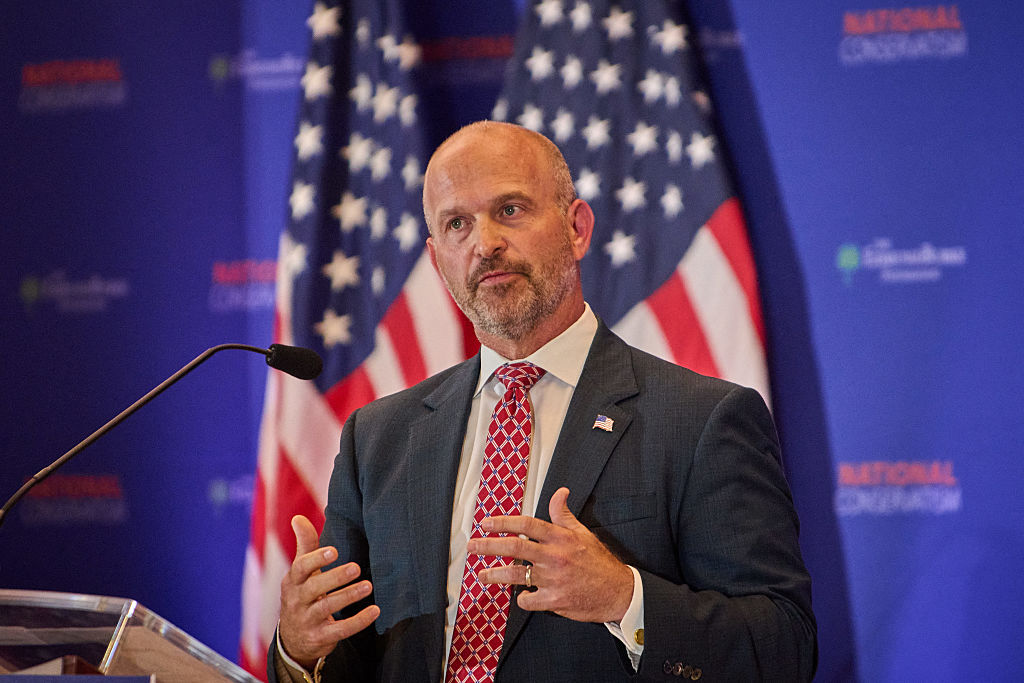
This has been adapted from a speech titled “The Myth-Maker as Nation-Builder,” which was delivered by Jonathan Keeperman, who runs publishing house Passage Press, at the National Conservatism Conference 2025.
As W.B. Yeats once said: “There is no great literature without nationality. There is no great nationality without literature.” People often ask me whether it is possible to produce right-wing art, or otherwise to use art to engineer a more nationalist politics. But this strikes me as backward thinking. Culture is the field in which a people encounters the shared symbols and language that make political life possible. Art, done well, discloses the deeper truths a people already carry within themselves. Art therefore does not produce the nation; it reveals the nation.
What is art trying to accomplish? This wanders a bit into the philosophical weeds, but I think it’s important to begin here. The purpose of art is to reveal what is capital-T true about the world and our experience in it. Some statements, stories, films, pieces of music have the quality of “truthness,” and some do not. Neither “truthness” nor “untruthness” is merely imagined or constructed. Some things are true and some things are not.
But language alone cannot determine what is true and what is not. Argument alone cannot mediate our disagreements. Resorting only to language leaves us with such mistaken phrases as “Beauty is in the eye of the beholder.” This is wrong. This is also dumb. But it points to the difficulty of arguing our way into a shared understanding of what is or is not true.
Rather, capital-T truth is felt, not something that is asserted. It is revealed to us, or unconcealed from us. Truth is disclosed. The philosopher Martin Heidegger talks about this as aletheia. Truth is about unconcealing reality, not being merely correct. We can then say that art is true when it creates the emotional and spiritual conditions for the world to be revealed, much like how a profound dream allows the mind to reveal itself to itself.
For those who find Heidegger a little too abstruse, I offer Mr. Miyagi from The Karate Kid. Mr. Miyagi’s task is to train his pupil to become an expert at karate. But he doesn’t do this directly. If you recall the movie, Mr. Miyagi teaches a young Ralph Macchio through a series of household chores: painting a fence, cleaning a car – “Wax on! Wax off!” The philosophical lesson contained in this truth is unconcealed only when it is lived into and becomes embodied. As Sensei Miyagi says: “Lesson not just about karate. Lesson about whole life.”
One of the bedrock properties of truth is that it coheres and it endures. Truth is lindy – it lasts. Falseness succumbs to entropy. To survive, it must be propped up and artificially stabilized. False stories, false art are brittle. Lies are brittle. Truth obtains.
With this framework, we can understand artists as nation-revealers. First, understand that nations are constellations of enduring truths about a people, an embodied people. It’s their histories, their language, their rituals, their ways of being that cohere over time. When they no longer cohere, there is no longer a nation to speak of. Second, understand that artists and their art unconceal those truths about the people, preparing the mind and spirit so that those truths can become embodied and felt. The conclusion here is that it is therefore not the artist’s job to assert or construct or build the nation. It is the artist’s job to reveal the nation to itself.
What are some examples of artists as nation-revealers? The first that came to mind for me was Theodor Herzl’s novel The Old New Land. He wrote this in 1902, while he was still in Austria. It’s a terrible novel. The dialogue is wooden; the characters are flat; the plot is stitched together absurdly. Its utopian vision of a future state of Israel is very naive and implausible – in a word, false.
But it does have one redeeming quality in the form of a more enduring capital-T truth: the novel reveals the longing of European Jewry for the possibility of a nation, a nation reborn. And what Herzl’s book does is project a future in which Jews could and eventually do live.
A less obvious example of nation revealing from this same period is the poetry of Yeats in Ireland. Yeats is reimagining Irish nationalism on the precipice of the war for independence. This came a couple of decades later, but he embarks on this very self-conscious cultural project right at the tail end of the 19th century. The poet is a Protestant, not a Catholic, who speaks English, not Irish, and is an avatar for this emergent Irish culture.
His identity and art force a series of questions: is there such a thing as Ireland? And if so, what is it? Is there an Irish people? Who are they? Is Ireland Celtic? Is it Christian? Catholic? Republican? Norse? Danish? Scottish? Is it English? And how do all these different origin stories potentially fit together? Can some truth cohere out of this cultural mosaic? Through Yeats’s art, can Irishness be revealed and lived into by its people? Among all these disparate parts, can a shared identity be embodied?
Yeats creates this identity not by projecting a future, like Herzl, but rather by looking into a mythic past. Following the insight that nationalism is first a state of mind, Yeats understood that to change the national state of mind, you must change what that mind feels to be true. He adopts a few strategies to achieve this. We know from his autobiographies that he did so intentionally.
First, he revives the old Irish tradition of the poet as a central political figure. In the poem “To Ireland in the Coming Times,” he places himself in the pantheon of great Irish poets of the past who conferred legitimacy on their kings and often spoke on their behalf. The point of this for Yeats is to assert the importance of the role of the artist and of art more broadly so that the pronouncements of the artist carry the weight of political authority.
He also deliberately and explicitly excavates the stories and heroes of the medieval Ulster Cycle. These poems are some of Yeats’s most well-regarded and demonstrate his real literary genius. They are self-consciously nostalgic and homesick for a lost Ireland that begs to be reclaimed, but without the cloying sentimentality that usually comes with these qualities. They also maintain a kind of mythic grandeur and supernatural magic that elevates them above mere history and above the specific ethnoreligious claims of any particular contemporary Irish subgroup while still being squarely grounded in a recognizably Irish tradition.
Finally, Yeats understood that a nation’s art, if it is indeed going to bind the nation, must not be too insular. His Abbey Theatre, which he opened in 1904, puts his mythic poems on the stage where they can be more viscerally felt and made into a more central part of Irish cultural life. Yeats explained: “I am no longer writing for a few friends here and there, but I’m asking my own people to listen, as many as can find their way into the theater.” Perhaps through plays – where one has more room than in songs and ballads – one can explain those elaborate emotions and intricate thoughts that are oneself.
What about America? The truth is that neither the examples of Herzl nor Yeats are applicable to us now. Our situation is very different. We do have an established past. We have a self-understanding of our founding. We reinterpret and negotiate that founding often – there are disagreements about motivations and intentions – but there is no disagreement about when and where and what it is. We agree that it happened when the Founders convened. We can point to Plymouth Rock. We can walk the battle green at Lexington.
What we lack is confidence in our present. We do not need a Herzl to conjure a future or a Yeats to excavate a buried origin. We need artists who can reveal what America is now. Think again of Mr. Miyagi. His pupil will not be told. He must be led by indirection from self-doubt into confidence. Perhaps it is the case with our own self-conception. Now our cultural life is very confused, attenuated, lacking confidence, lacking coherence. It is too fragmented. It is self-antagonizing and it will not be explicitly directed. A durable national identity cannot be asserted into being.
I’ll conclude with a poem that models an oblique kind of revelation of the type we ought to encourage would-be artists to consider carefully. This comes from William Carlos Williams, a 20th-century modernist poet. The poem is called “The Red Wheelbarrow” (1923):
so much depends upon a red wheel barrow glazed with rain water beside the white chickens
I will not elaborate further.
This article was originally published in The Spectator’s December 8, 2025 World edition.









Leave a Reply