


 Facebook
 X
X LinkdIn
 Copy Link
Since the end of the Cold War, politicians and commentators have been searching for a new paradigm through which to understand international relations. Notwithstanding Francis Fukuyama’s oft-misunderstood The End of History, we have tried various patterns to classify the world order, of which George W. Bush’s “Axis of Evil,” first used in 2002, was among the more enduring.
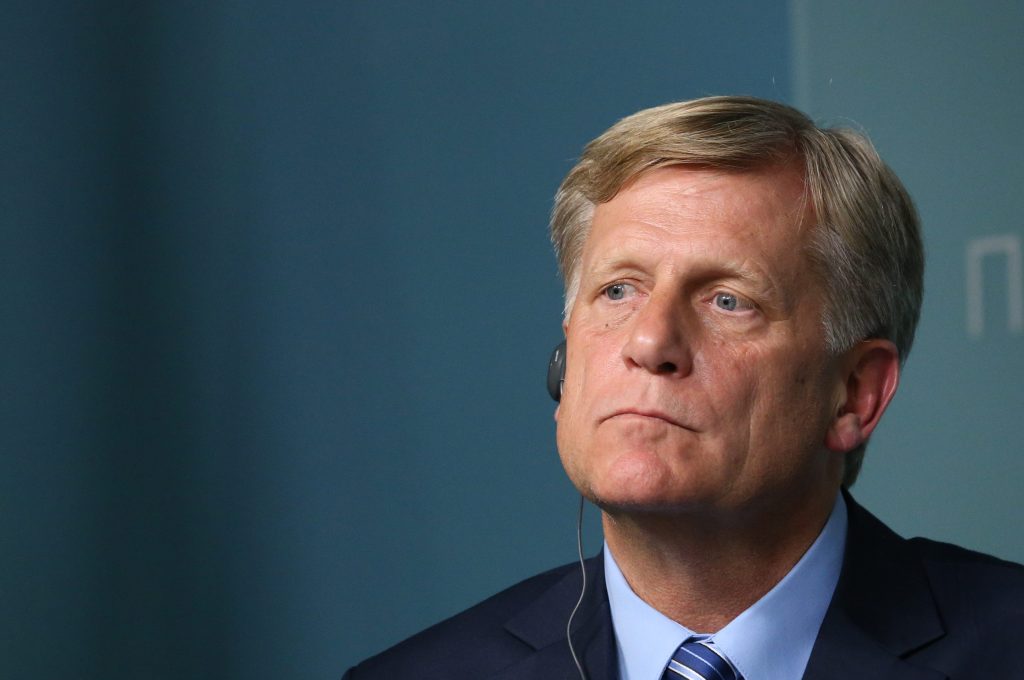
In Autocrats vs. Democrats: China, Russia, America, and the New Global Disorder, Michael McFaul acknowledges the widespread if nebulous consensus that the challenge presented by Russia and China is a kind of second Cold War – historian Niall Ferguson has labeled America’s relations with China “Cold War II.” But McFaul rejects the easy creation of a model which is reminiscent of past conflicts, arguing that it fails “accurately [to] describe the complex, unique dynamics of our current era of great power competition.”
While McFaul’s analysis draws on his experience as a social scientist and a historian, he also dons his “policymaker hat” to provide a solution as well as commentary. Whether one agrees with his prescriptions or not – of which more anon – for that, at least, we should be grateful. It is easy enough to lament, to use Seán O’Casey’s phrase, that “th’ whole worl’s in a terrible state o’ chassis,” but considerably more demanding to say what can and should be done about it.
There is a touch of the straw man around the edges of McFaul’s arguments. When he explains that “China is not an existential threat to the United States or the free world,” for example, he is suggesting a position which few serious foreign policy observers hold. Indeed, it is hard to say what a truly existential threat to the US would look like – at least a foreign one. As a young Abraham Lincoln told his audience in Springfield, Illinois, in 1838: “All the armies of Europe, Asia and Africa combined could not by force, take a drink from the Ohio, or make a track on the Blue Ridge… if destruction be our lot, we must ourselves be its author and finisher. As a nation of freemen, we must live through all time, or die by suicide.”
One current difficulty lies in characterizing the foreign policies of the Trump administration. McFaul notes, correctly, that the President, on returning to the White House, “immediately withdrew the United States from the Paris Climate Accords, the World Health Organization and the UN Human Rights Council.” It is hard to think of a multilateral institution that Donald Trump likes or trusts, from the UN to NATO to the World Trade Organization. McFaul sums this up as “an even stronger commitment to an isolationist agenda.”
But that will not quite do. President Trump authorized major air strikes on Iran’s nuclear facilities in June; he is escalating military action against drug cartels in the Caribbean Sea, declaring that the US is at war with the drug cartels and creating a Joint Task Force within US Southern Command to coordinate strikes; he has interposed himself as a “peacemaker” between India and Pakistan, Armenia and Azerbaijan and, most recently, in the Middle East. This is hardly shutting out the rest of the world and focusing on domestic concerns.
What, then, would the former ambassador and director of Stanford’s Freeman Spogli Institute for International Studies advise the nation’s chief executive to do? McFaul advocates selective but not complete economic decoupling from China, lifting most of the tariff barriers Trump has imposed and encouraging American investment abroad, attracting Russian and Chinese scientific, technological and entrepreneurial talent to the US. He also argues that “defense is only part of a successful strategy. America needs more offense,” though it is hard to see him and Secretary of Defense Pete Hegseth agreeing on the implementation of that statement.
Fundamentally, McFaul believes in international cooperation and in multilateralism, not only for America’s prosperity and security but also as a way of prying apart the ad hoc and transactional alliance which currently holds sway between Moscow and Beijing. I freely confess to being an enthusiast for informed debate and vigorous but respectful exchange of ideas, and someone with McFaul’s background should be listened to as America decides how to approach international relations.
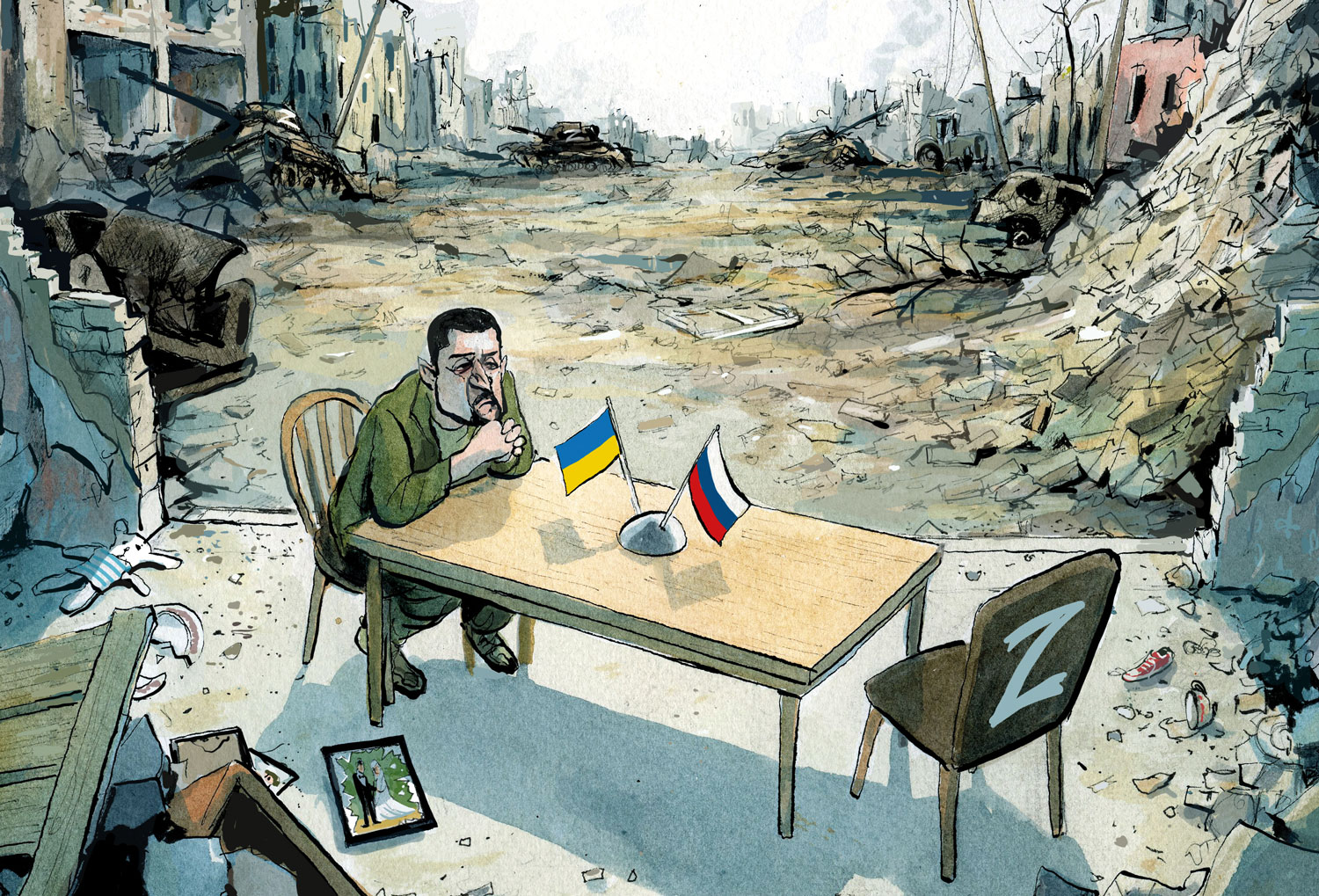
However, Autocrats vs. Democrats founders on two obstacles. The first is the highly personal and utterly unpredictable nature of Trump’s foreign policy. The President has few guiding principles save his own instincts and his attitudes can turn on a dime, making it very difficult to formulate any coherent kind of framework which can direct American policy. As we have seen with his wildly varying views on Ukraine and Russia, it sometimes feels as if he himself does not know what he will think tomorrow – making it a sheer impossibility for anyone else.
More broadly, there is a feeling that American politics is not currently amenable to debate, discussion and exchanges of information. While the extent to which the electorate is polarized may be exaggerated, politicians certainly seem to have retreated to entrenched positions and debate can seem like a concession to a sworn enemy. In that respect, there is something slightly old-fashioned about McFaul’s book. He may have prepared an intellectual case and a list of detailed propositions, but it feels as if his audience has long since left, taken up arms and rushed to the ideological barricades.
This article was originally published in The Spectator’s December 8, 2025 World edition.








Leave a Reply